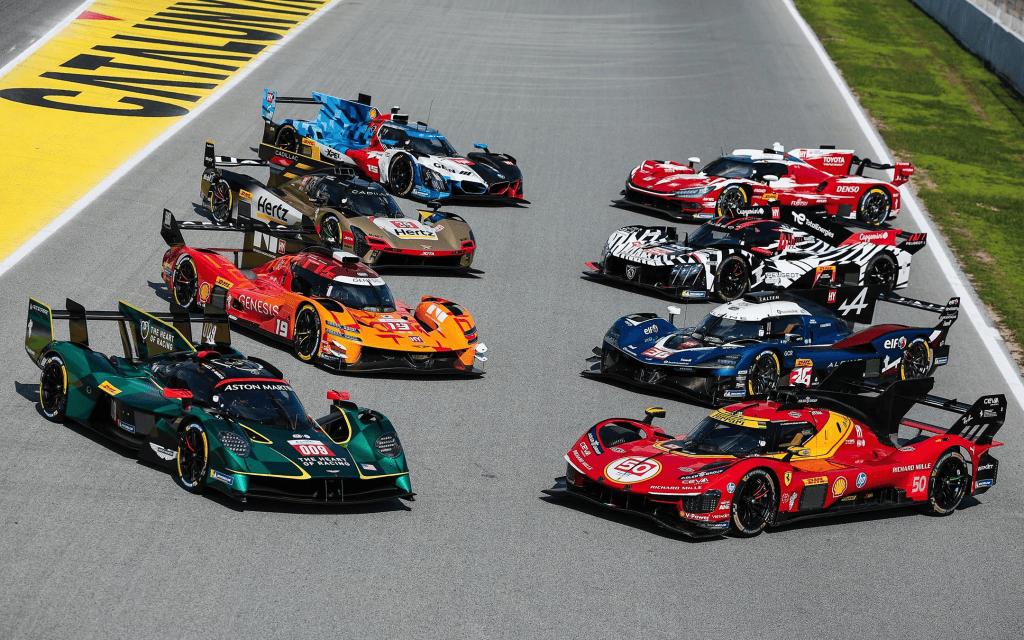
Beautiful machines at a new location… Unpredictability? Nowhere to be seen!
The chequered flag has been waved upon the World Endurance Championship’s maiden Barcelona race outing, and the title picture for the Hypercar class could not be clearer: it’s Toyota vs. Toyota for the Drivers’ Championship come the Monza season finale, on top of the Japanese brand wrapping up its seventh WEC Manufacturers’ title after scoring four victories in seven rounds, delivering masterclass upon masterclass while fulfilling the promise of their heavily revised TR010 Hybrid.
To look back at this weekend’s action brings a conflicting range of emotions: the anticipation of a last-minute addition to the calendar as a Qatar replacement, the unexpected thrill of watching Mathys Jaubert capture pole position on Saturday for a fledgling Genesis, and the very mixed bag of the race itself on Sunday – six hours of very mixed conditions, high tyre degradation, and difficult overtaking in spite of traffic.
Not to mention an absolutely untouchable, unopposed performance by the aforementioned duo of Japanese cars.
From the very beginning – Genesis’s traction control problems throwing them immediately out of the picture notwithstanding – we appeared to have returned to the early period of the Hypercar class, when the newcomers still figured themselves out while Toyota made it look easy, scampering ahead and dominating proceedings. Safety Car restarts proved not to be an issue, with the substantial intervals between the second-placed Toyota and third-placed competitor – this time, the #50 Ferrari – reappearing just as soon as the green flags were waved, growing larger still over the long stretches of green flag running.
To echo a very famous quote from sometime last year… It was just like watching a “two-class race”, within the Hypercar field. A quick glance at the performance report for the class from The B-Pillar shows the pair of Toyotas were the only ones capable of laying down times in the low 1:32:000 bracket – courtesy of Kamui Kobayashi and Ryō Hirakawa – once conditions were dry enough to be properly representative, a whopping 1.3 seconds quicker than the next fastest time set by the #50 Ferrari, while averaging roughly half a second faster over a dry stint – if not more, as interpretations of the report might be skewed due to all the wet weather running early on.
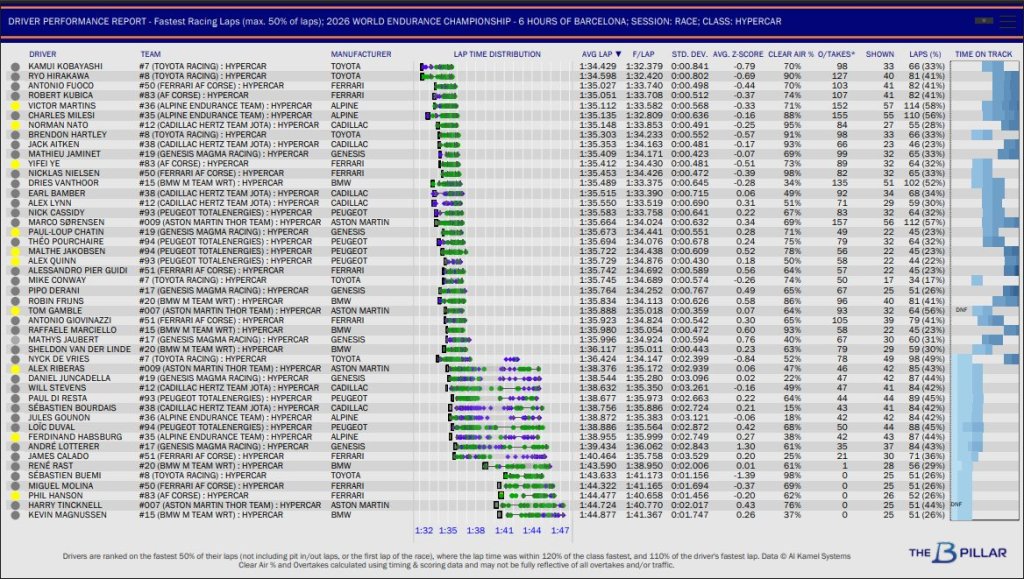
The tables don’t lie.
Now, before any jumps to conclusions can be made about the nature of this article, it is very much understood that Toyota – alongside Cadillac, BMW, and Alpine – brought out an upgraded prototype for this season, aiming to reduce their disadvantage to the opposition and smooth out previously existing limitations. It has worked out beautifully for all involved parties, with every single brand figuring at the front of the pack at some point this year, and, up until this weekend, BMW being the other main contender for the title after winning twice.
It is not too far-fetched, we can agree, to point out that the ACO completely missed the mark for Barcelona specifically, after a commendably balanced year after the horrors of 2025 – first favouring a manufacturer that turned up with a massively upgraded car (Ferrari) before massively holding it back as part of a knee-jerk reaction after four consecutive triumphs. Paired with Barcelona’s unknowns, its naturally abrasive nature, and the mostly mixed conditions encountered throughout the initial two thirds of the race – favouring the LMH machinery against the LMDh entrants – the stage was set for a complete Toyota walkover.
Given this round also happened to be the one where the team clinched the manufacturers’ title, it left a somewhat bitter aftertaste in the throats of many, when the big picture is considered – naturally, not much could’ve been done when other title contenders’s misfortunes are considered (looking at you, WRT BMW #20). Still, talk about an anticlimax.
Speaking about anticlimactic scenarios, a parallel can be traced to the messy situation in IMSA GTP throughout this year, where all the contenders (Porsche and Acura, in addition to the aforementioned BMW and Cadillac) but Aston Martin brought in upgrades. The latter, particularly through its red Whelen #31 entry, scored six straight podium finishes, including back-to-back victories in Detroit and Watkins Glen – by that point, any hopes for its championship rivals hung on something miraculous, Road America clash happening or not.
This lack of “reeling back” by the series organisers, again, had plenty of fans and media sitting mystified. Is there a way to simply negate the impacts of Balance of Performance? Was the series considering the average performance between the three Cadillac entries? Or did it have to do with Action Express’s ownership connections?
What we can say for certain is that 2027 is right around the corner, bringing with it more upgraded entries – this time, the Valkyrie and, once again, the 499P, now with more substantial design revisions – as well as new contenders in the shape of McLaren and Ford. Will we see a repeat of what happened in 2025, or this Barcelona weekend, or IMSA this year? Has the ACO figured out a way to avoid gifting a manufacturer such a blatant advantage?
For the good of the sport, we sure hope they did.


Leave a Reply